

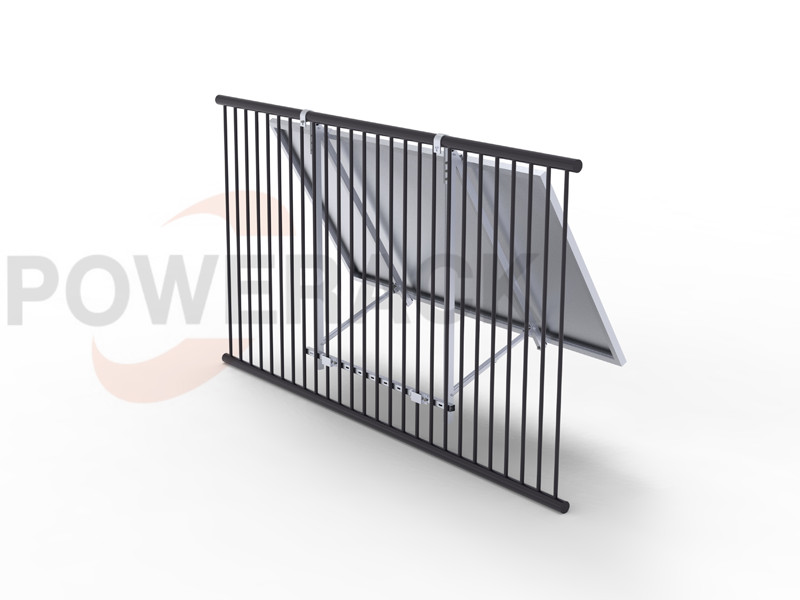
1. Structural Safety Risk
Railings and building structures lack sufficient load-bearing capacity. A standard-sized photovoltaic module with its mounting system can weigh 15–25 kilograms. When this weight is applied to railings, the resulting leverage effect multiplies the actual load, potentially exceeding the design limits of both the railing itself and its connection points to the wall.
Weak wind resistance during extreme weather may cause balcony railing solar mounting systems to detach, leading to falling objects from heights and structural damage.
2. Difficulties in installation and adaptation
The choice of connection method becomes a technical criticality due to differing railing materials (metal/concrete). Chemical anchors, mechanical expansion bolts, and specialized clamps each have applicable scenarios and limitations. For instance, expansion bolts are suitable for concrete railings, while thin-walled metal tubes require avoiding drilling holes and instead using clamp-style connections.
Shape compatibility presents further complexity. Circular, square, and irregular-shaped railings each demand distinct clamp designs; even minor variations in railing diameter or width can prevent brackets from achieving a snug fit. Universal brackets offer poor adaptability, potentially resulting in unstable installations and safety hazards.
3. Electrical safety hazards
Common mistakes made by DIY installers include: using mismatched cable specifications, neglecting grounding protection, and insufficient waterproof ratings for junction boxes. Balcony environments are exposed to sun and rain, and any oversight in electrical connections can lead to short circuits, electrical leakage, or even fire hazards. This poses risks of fire, electric shock, or power backflow damaging grid equipment.。
4. Limited Power Generation Efficiency Urban balconies are not ideal locations for photovoltaic installations, as power generation efficiency is often constrained by multiple factors. Orientation and tilt angle issues are primary concerns, as most balconies have fixed orientations and non-adjustable tilt angles, preventing solar panels from receiving sunlight at optimal angles. In urban settings, shading effects are particularly pronounced. Adjacent buildings, the balcony structure itself, and even shadows cast by railings can partially obscure solar panels. Modern PV modules typically employ series circuits, where even partial shading can drastically reduce the power output of an entire panel or string.
More critically, prolonged partial shading may trigger the "hot spot effect"—where shaded cells transform from power generators into heat sinks, generating localized high temperatures that accelerate module degradation and pose potential safety hazards.
Add : 606, No. 12, Huasheng Road, Huli District, Xiamen,China
WhatsApp : +86153 9592 2968
Email : info@powerack.com



 English


