

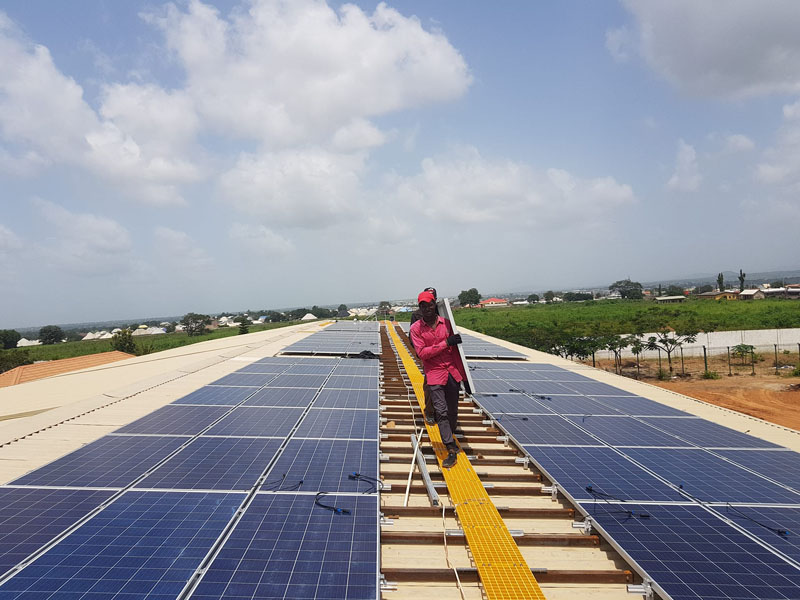
I. The Ultimate Challenge for High-Rise Roofs
Installing photovoltaic systems on high-rise buildings presents far more complex challenges than those encountered on ordinary villas or factory roofs:
Stringent Load Restrictions
Weight is critical: Roof structures in high-rise buildings are engineered with extreme precision, often bearing loads hundreds of times more demanding than low-rise structures. Any weight exceeding design specifications—including mounting systems, PV panels, wind loads, etc.—can cause roof sagging or cracking.
Wind Pressure and Airflow: High-rise buildings are highly susceptible to wind forces. The wind pressure coefficient (CF) often reaches 1.5–1.6 at elevated heights, meaning supports must withstand 50% greater wind loads than ground-mounted solar plants—or even more.
Optimal Utilization of Space and Layout
Limited Space: High-rise rooftops are typically designed as equipment rooms, atriums, or helipads, offering limited usable area. Maximizing the arrangement of photovoltaic modules within this constrained space is the core design challenge.
Safety and Maintenance
Fall Protection and Maintenance: Working at heights poses significant risks, and any failure of the scaffolding system can create major safety hazards. The scaffolding system must be exceptionally stable, and maintenance and replacement must be extremely straightforward.
II. The Breakthrough of Aluminum Alloy Brackets
Traditionally viewed as lacking sufficient strength, aluminum alloy brackets have emerged as the preferred choice for high-rise roof renovations due to their exceptional capabilities:
Weight Halved, Lifespan Doubled
Weight Advantage: Aluminum alloy brackets have a density just 30% that of steel, meaning they are 70% lighter than steel brackets while maintaining equivalent strength.
Practical Significance: For high-rise rooftops, this not only solves the "excess weight" challenge but also significantly reduces stress on the roof structure, eliminating reinforcement costs.
Longevity Advantage: Aluminum alloy offers exceptional corrosion resistance, eliminating the need for painting and resulting in minimal maintenance costs. With a lifespan of 25-30 years, it perfectly aligns with the operational life of photovoltaic modules.
Optimized Strength and Rigidity
Ultimate Strength: Modern engineering-grade aluminum alloys (e.g., 6061) are designed to meet wind load requirements for high-rise roofs. By optimizing profile cross-sections (e.g., adding stiffeners, using double- or triple-sided profiles), aluminum alloy mounts achieve 70% of steel mounts' load-bearing capacity—sufficient for practical wind load requirements.
Modular Design: Aluminum alloy mounting structures typically employ modular assembly for enhanced structural rigidity and wind resistance.
Ultimate Fabrication and Installation
"Photovoltaic Quick Assembly": Aluminum's machinability enables "pre-assembly" of brackets. Prefabricated at ground-level factories, brackets arrive on-site ready for placement—eliminating on-site welding or drilling and drastically reducing installation time (by 30%-50% compared to traditional steel brackets).
Fine-Tuning Capability: Aluminum alloy racks typically feature micro-adjustment screws, enabling precise module angle calibration to maximize power generation in complex shadow environments common in high-rise buildings.
Add : 606, No. 12, Huasheng Road, Huli District, Xiamen,China
WhatsApp : +86153 9592 2968
Email : info@powerack.com



 English


