

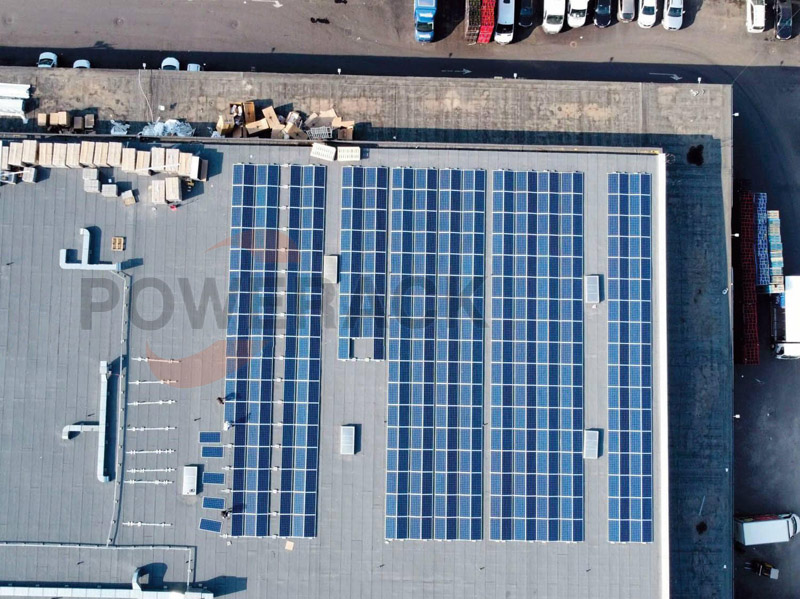
1. Principles for selecting supports for flat concrete roofs
A. Combining structural stability with waterproofing
Concrete flat roofs have a high load-bearing capacity, but their waterproofing layers are vulnerable. The support system should, as far as possible, avoid damaging the waterproofing layer, or, where penetration is necessary, provide reliable measures to ensure a watertight seal.
B. Adapt to the roof pitch
Most flat concrete roofs have a low pitch (usually less than 10 degrees), so the mounting system requires counterweights or structural reinforcement to ensure the stability of the photovoltaic modules and prevent them from shifting in strong winds or due to rainwater runoff.
C. weather resistance
The material used for the brackets must be highly corrosion-resistant; hot-dip galvanised steel or aluminium alloy is usually selected.
2. Main types of scaffolding systems
Given the specific characteristics of flat concrete roofs, the market primarily offers the following solutions:
This is the most common solution and offers the best waterproofing performance. It primarily uses ballast to secure the brackets, thereby avoiding penetration of the roof.
Features: Does not damage the roof waterproofing layer and is suitable for areas with strong winds.
Implementation methods:
Concrete pedestal foundations: Concrete pedestals are cast on the roof, and the brackets are installed once they have fully cured. The advantage is stability; the disadvantage is a longer construction period, as the concrete must be allowed to cure.
Precast concrete blocks: Precast concrete blocks are used in place of on-site casting, resulting in faster construction.
B. Precast Block System
Similar to the ballasted solar racking systems, but using specialised precast blocks to provide weight and support.
Features: Rapid installation and short construction times. This is achieved by mounting the photovoltaic modules directly onto the precast concrete blocks, or by securing the mounting frames to these blocks.
C. Angle Aluminum/ Triangular Bracket
This is a classic mounting structure designed for flat roofs.
Features: Sturdy and highly adaptable. It is typically constructed using aluminum angle profiles to form a triangular structure that supports the solar panels.
Applications: Depending on the roof’s load-bearing capacity and waterproofing requirements, different mounting methods (such as expansion bolts or clamps) can be selected.
D. Adjustable Angle Ballast System
Designed for projects requiring angle adjustment.
Features: The tilt of the solar modules can be adjusted by sliding the clamps to accommodate different latitudes and irradiance conditions, thereby maximizing power generation.
Applications: Ideal for commercial rooftop projects that require precise angle adjustment.
Add : 606, No. 12, Huasheng Road, Huli District, Xiamen,China
WhatsApp : +86153 9592 2968
Email : info@powerack.com



 English


