

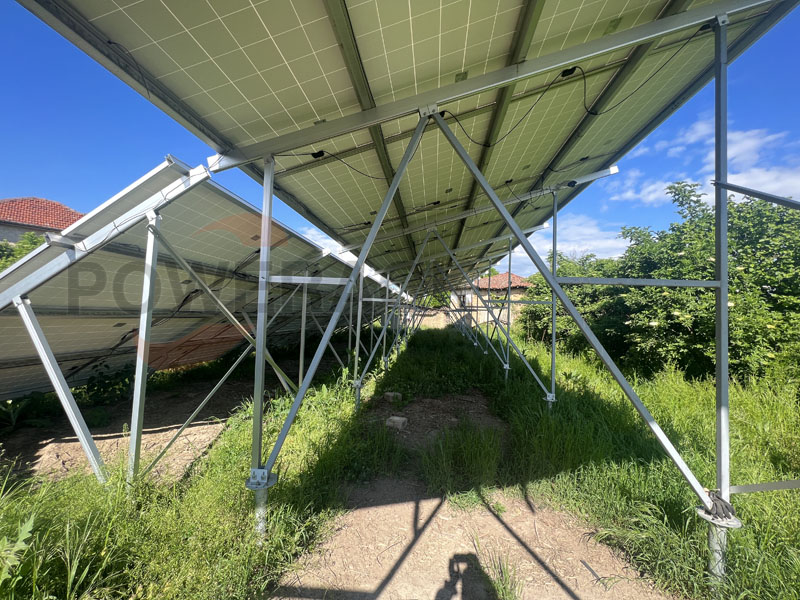
Many property owners and contractors have questions: Since aluminum alloy brackets are lightweight and made of a soft material, are they more prone to deformation than carbon steel brackets? The answer is: Aluminum alloy brackets that meet national standards will not deform under normal use; bending, sagging, or twisting only occur with non-standard, substandard aluminum brackets, incorrectly sized brackets, or improper installation. Aluminum alloy brackets are not “soft or unreliable”; rather, they require scientifically determined wall thicknesses, reasonable spans, and standard mechanical designs.
Standard photovoltaic aluminum alloy mounting systems are made from high-strength, aerospace-grade aluminum that has undergone an aging hardening process. They offer high strength, good toughness, and strong wind resistance, fully meeting the 25-year service life standards for photovoltaic systems. Their primary advantages include light weight, corrosion resistance, and maintenance-free operation—they do not rust—making them ideal for older roofs, color-coated steel roofs, and roofs with relatively low load-bearing capacity. As long as the specifications are selected to match the operating conditions, the systems will not bend, sag, or deform over the long term.
The deformation issues with aluminum brackets found on the market almost always stem from three types of substandard conditions: First, non-standard profiles with excessively thin walls; small manufacturers use lower-grade aluminum to cut costs, resulting in insufficient strength, making the brackets highly prone to bending under wind vibrations and snow load; second, installation spans that are too wide, exceeding the mechanical load-bearing limits of the profiles, leading to sagging and deformation due to prolonged stress; Third, on-site violations such as stepping on the structure, forcibly bending or adjusting it, or applying heavy pressure to a single point can cause irreversible twisting and deformation.
Compared to carbon steel brackets, high-quality aluminum alloy brackets offer greater stability. Carbon steel brackets are most vulnerable to rust and thinning; they weaken with use and are prone to overall deformation and collapse over time. Aluminum alloys, on the other hand, have a natural oxide protective layer that prevents rust and corrosion for their entire lifespan, ensuring that structural strength does not diminish over time. As long as the initial selection meets standards, spans comply with regulations, and installation follows proper procedures, aluminum brackets offer superior long-term stability compared to ordinary hot-dip galvanized carbon steel brackets.
To prevent deformation of aluminum brackets, simply focus on three key points: select T6 high-hardness aluminum alloy in accordance with national standards, with standard wall thicknesses that have no negative tolerances; strictly control bracket spans based on mechanical design specifications and do not arbitrarily increase spacing; during installation, avoid stepping on the profiles and refrain from forceful adjustments to ensure even force distribution across components. POWERACK uses certified aluminum alloy brackets that remain deformation-free, secure, and maintenance-free for 25 years.
FAQ:
Q1: Which is less prone to deformation—aluminum alloy brackets or carbon steel brackets?
Under the same national standard specifications, both meet structural stability requirements. Aluminum alloy offers consistent strength, never rusts, and becomes more stable with use; carbon steel is prone to rust and thinning over time, posing a risk of deformation year after year. Aluminum alloy brackets are the preferred choice for older roofs and coastal areas.
Q2: Can aluminum brackets still be used if they’ve deformed?
Minor bending can cause uneven stress distribution across the modules, leading to hidden cracks and hot spots. Severe deformation can alter the array’s wind-resistant structural integrity, posing a risk of component detachment. As soon as visible deformation occurs, it is recommended to replace or repair the brackets promptly; continued use in this condition is not advised.
Q3: Why do some aluminum brackets bend after just one year of use?
This is almost always caused by non-standard thin-walled aluminum profiles, excessive span lengths, or foot traffic during installation—not by the material itself. Genuine, national-standard aluminum brackets from reputable brands have undergone wind load structural analysis and can withstand strong winds, snow, and vibrations over the long term without easily deforming.
Add : 606, No. 12, Huasheng Road, Huli District, Xiamen,China
WhatsApp : +86153 9592 2968
Email : info@powerack.com



 English


